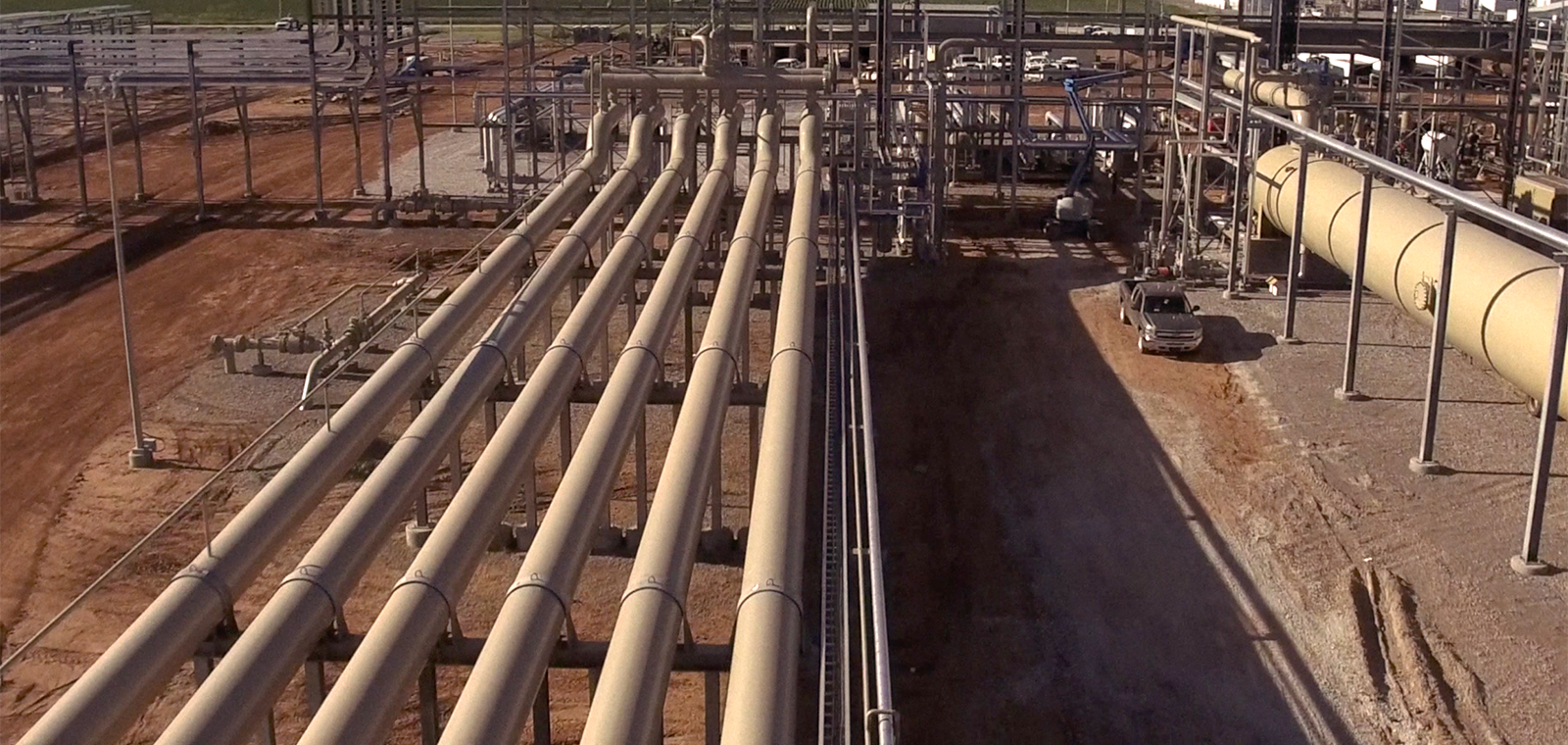
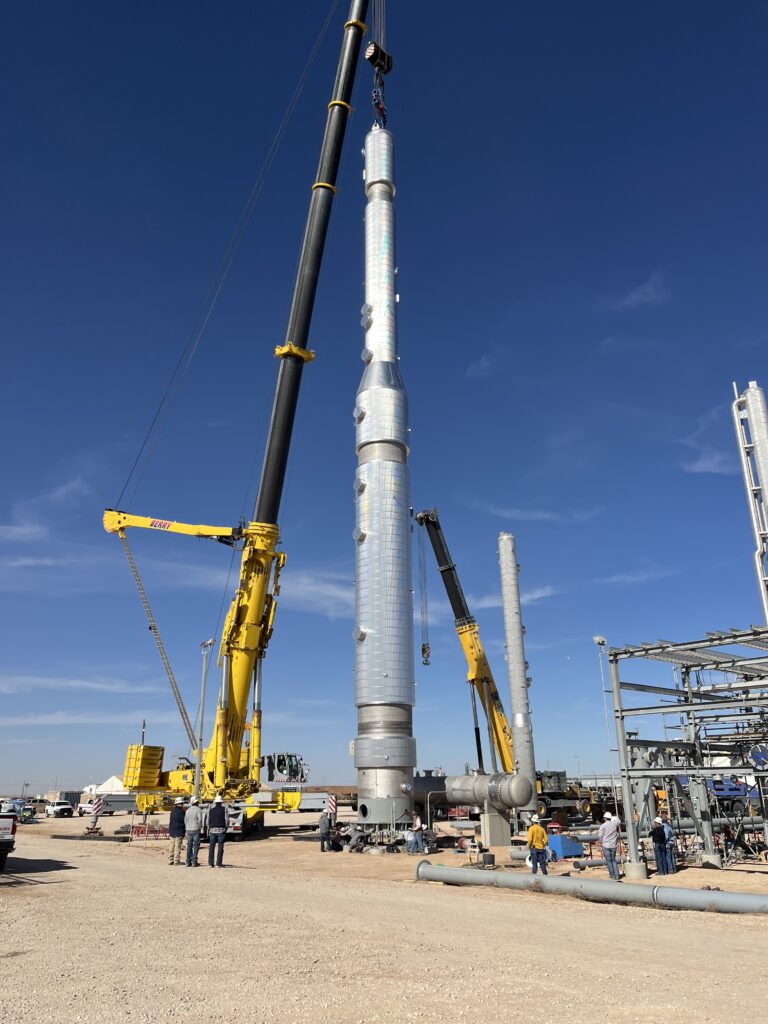
BCCK, a leader in engineering, procurement, fabrication and field construction services, has been awarded a 200 MMSCFD nitrogen rejection unit (NRU) for a natural gas processing facility in the Permian Basin.
The NRU is designed to extract nitrogen from the residue gas of an existing cryogenic gas processing facility and incorporates BCCK’s Style IV NiTech® NRU technology. The unit has been engineered to allow for a future upgrade to BCCK’s NiTech® ultra-low methane (ULM) technology, enabling an ultra-clean vent. This project represents a key milestone in BCCK’s ongoing advancement of ULM-ready NRU designs.
Kevin Blount, BCCK president, said, “BCCK is proud to have been selected to deliver its nitrogen rejection technology to a repeat client. BCCK’s engineers worked closely with the customer’s engineers and operators to develop a robust design that can handle the challenges of swinging flow rates and pressures upstream of the NRU and allow for a simple future upgrade to our ultra-low methane technology.”
By designing the NRU with upgrade flexibility, BCCK enables operators to plan future emissions reduction initiatives while maintaining reliable performance under variable operating conditions. The project further demonstrates BCCK’s depth of experience in nitrogen rejection and its continued focus on practical, scalable engineering solutions.
A Process Engineer I is responsible for assisting Senior Process Engineers and Process Engineers II with the conceptual and detailed design of the processes and chemistry included in each company’s prospective and contracted projects. The Process Engineer I will be involved in multiple projects simultaneously, with projects at different stages, at any given time. This position will be under the direct supervision of the Director of Process Engineering.
Responsibilities:
Reasonable accommodation may be made to enable individuals with disabilities to perform the essential functions
Utilizes the process simulation software to develop and optimize conceptual and detailed designs of the processes to be utilized in the execution of the company’s prospective and contracted work.
Develops and maintains spreadsheet tools for the detailed design of equipment and systems required for contracted work
Develops and reviews process specifications for equipment pertinent to the execution of the job
Works with other engineering and design staff in the development of Process Flow Diagrams and Piping and Instrument Diagrams (P&IDs) for each project
Performs system studies to ensure cohesion of equipment and physical equipment orientation within systems for design purposes
Basic recognition of appropriate company and industry codes and ensure conformance of specified systems and equipment
Works with the Project Detail group to solicit quotations for components from potential suppliers as predetermined by other engineering, design, project management and this position
Completes evaluations of returned quotations, makes selections based on that evaluation and returns completed forms to Project Management for review and final approval.
After final approval, provide final specifications, including equipment specifications, selected vendors, pricing and any other pertinent data to the Project Detail group for execution of the purchase of the required equipment
Participate in operability and hazard assessments (PHA or HAZOP) for the safe operation of facilities to be built.
Develops conceptual control system design and communicates with appropriate Control Systems Specialists for optimized and safe control system design, installation and functionality
Develops and/or reviews Cause and Effect Diagrams for intention and functionality for safe and effective process operation
Support in training of client operations staff on the design and operational intent of the provided equipment
Support plant operations personnel in the commissioning and startup of completed process systems
Provides technical support and troubleshooting of ongoing client process operations, as required
Participates in project meetings at the request of the Project Manager
Prepares for daily interaction with other Engineering, Design, Project Detail, Project Manager and fabrication personnel as well as vendors.
Context & Relations
The Process Engineer maintains relationships with the BCCK staff as well as other vendors, adhering to BCCK guidelines. The Process Engineer also maintains direct contact with other Engineering, Project Assistants, Project Management and upper management, serving as the focal point of communication for different groups as it relates to the process design.\
Job Requirements
Good knowledge of Word, Excel and other software tools as required for the job
Strong organizational skills and attention to detail as well as technical writing and documentation skills
Familiarity with company and industry codes and standards applicable to the gas processing industry
Ability to cope with fast-paced, rapidly changing project requirements
Analytical and problem-solving skills
Ability to interact with vendors and provide assistance to various BCCK departments
General understanding of projects, contract terms, concepts and terminology
Must be highly motivated, customer focused, able to prioritize, detailed, capable of multitasking, able to follow throiugh on all tasks to completion
Some travel for equipment inspection and plant startup and commissioning will be required.
Physical Demand
The physical demands described here are representative of those that must be met by an employee to successfully perform the essential functions of this job. While performing the duties of this job, the employee is required to stand, walk, and sit, use hands to finger, handle or feel objects, tools, or controls, reach with hands and arms, climb stairs, balance, stoop, kneel, crouch or crawl, speak and listen, taste or smell. The employee must occasionally lift and/or move objects up to 25 pounds. Specific vision abilities required by the job include close vision, distance vision, color vision, peripheral vision, depth perception, and the ability to adjust focus.
Work Environment
This job operates in a professional office environment. This role routinely uses standard office equipment such as computers, phones, photocopiers, filing cabinets and fax machines. The job also operates in a construction setting as well as in fabrication shops. The ability to move between settings is vital for this role.
Position Type/Expected Hours of Work
This position is a full-time, exempt, 40-hour per week employment. Overtime hours are usually required, depending on the phase of the project and project schedule, and may include weekends and evening work.
Travel
Frequent day trips and some overnight travel to domestic and international destinations will be expected for this position.
Required Education and Experience
Bachelor’s degree in Chemical Engineering from an ABET accredited university, or equivalent
Five years of related experience or equivalent combination of education and experience in engineering-related position.
AAP/EEO Statement:
BCCK Holding Company provides equal employment opportunities to all employees and applications for employment and prohibits discrimination and harassment of any type without regard to race, color, religion, age, sex, national origin, disability status, genetics, protected veteran status, sexual orientation, gender identity or expression, or any other characteristic protected by federal, state or local laws. This policy applies to all terms and conditions of employment, including recruiting, hiring, placement, promotion, termination, layoff, recall, transfer, leaves of absence, compensation and training.
Other Duties
Please note this job description is not designed to cover or contain a comprehensive listing of activities, duties or responsibilities that are required of the employee for this job. Duties, responsibilities and activities may change at any time with or without notice.
Natural gas processing has undergone significant transformations over the past several decades, with nitrogen rejection emerging as a critical component in maximizing hydrocarbon recovery. High nitrogen content in natural gas streams has historically posed substantial challenges for operators, making previously viable reserves uneconomical and limiting production potential. Understanding nitrogen rejection’s history and technological advancement provides valuable insights into how the industry has evolved to address these complex separation challenges.
Developing efficient nitrogen rejection processes represents a pivotal breakthrough in natural gas processing technology. From early recognition of the problem to implementing sophisticated cryogenic solutions, the journey of nitrogen rejection technology demonstrates how innovation drives operational excellence and economic viability in the energy sector.
Early Challenges and the Critical Need for Nitrogen Rejection
During the 1980s, natural gas operators faced mounting pressure from reserves containing elevated nitrogen concentrations. Traditional processing methods proved inadequate for these challenging compositions, often rendering otherwise profitable projects economically unfeasible. High nitrogen content created multiple operational difficulties, including reduced heating value, pipeline specification violations and increased transportation costs.
The separation of nitrogen from methane presented unique technical challenges compared to conventional natural gas processing. Unlike typical cryogenic distillation processes, nitrogen rejection requires simultaneously managing minor volatility differences, close boiling points and deep cryogenic temperatures. Combined with full heat integration requirements and complex two-phase flow conditions throughout the process, these factors created what industry experts described as a technical minefield.
Many operators discovered that their reserves contained nitrogen concentrations ranging from moderate to 90 percent, effectively stranding valuable hydrocarbon resources. The industry desperately needed a reliable, cost-effective solution to handle varying inlet conditions while maintaining high methane recovery rates.
The Innovation of BCCK and the NiTech® Process
Recognizing the critical gap in available technology, Clark Butts, founder of BCCK, developed and patented the revolutionary NiTech® nitrogen rejection process in the late 1980s. This breakthrough addressed the challenges natural gas streams face with volumes less than 30 MMSCFD, a market segment underserved mainly by existing technologies.
The NiTech® process represented a fundamental shift in the approach to nitrogen rejection. Rather than relying on complex, high-maintenance systems, Butts engineered a solution that prioritized simplicity, efficiency and reliability. The patented technology incorporated innovative heat integration strategies and optimized distillation techniques specifically designed for the unique characteristics of nitrogen-methane separation.
BCCK’s first NiTech® nitrogen rejection unit installation occurred in 1994 in Mist, Oregon, marking the beginning of the industry’s most successful nitrogen rejection technology. This pioneering installation demonstrated the process’s viability and established BCCK as the leading provider of nitrogen rejection solutions.
Applications and Capacity Range of NiTech® NRU Technology
The versatility of NiTech® nitrogen rejection unit technology extends across an impressive range of applications and capacities. Current installations serve natural gas streams ranging from 5 MMSCFD to 220 MMSCFD, but have been designed to over 500 MMSCFD, demonstrating the scalability and adaptability of the process design. This broad capacity range enables operators to recover previously uneconomical reserves due to nitrogen, CO₂, helium, oxygen or other contaminants.
The technology has succeeded in diverse applications, including conventional natural gas processing facilities, landfill gas operations and coal mine methane projects. Each application presents unique challenges, yet the flexible design of the NiTech® process accommodates varying inlet conditions while maintaining consistent performance standards.
Operators utilizing NiTech® technology can reduce nitrogen contents from 3 percent to 90 percent, down to as low as 1 percent, achieving hydrocarbon recovery rates typically exceeding 99 percent. This exceptional efficiency ensures maximum value extraction from challenging gas streams while meeting strict pipeline specifications.
Environmental Benefits and Methane Emission Reduction
Environmental stewardship has become increasingly crucial in natural gas processing operations, and the NiTech® nitrogen rejection process was explicitly designed with emission reduction as a core priority. The process architecture minimizes methane emissions through optimized recovery systems and advanced process control strategies.
Unlike many alternative technologies, the NiTech® process emits no non-methane volatile organic compounds (VOCs), contributing to cleaner operations and improved environmental compliance. The system’s design philosophy emphasizes methane conservation, ensuring that valuable hydrocarbons are recovered rather than lost to atmospheric emissions.
The environmental benefits extend beyond direct emission reductions. By enabling the economic recovery of previously stranded reserves, nitrogen rejection technology reduces the need for new exploration and development activities, minimizing the overall environmental footprint of natural gas production.
Success Stories and Industry Recognition
BCCK’s track record in nitrogen rejection speaks to the reliability and effectiveness of the NiTech® technology. With 46 successful NRU installations completed to date, BCCK has established itself as the most active NRU provider for over 20 years. This extensive operational experience provides invaluable insights that drive technology improvements and optimization strategies.
The success of these installations stems from BCCK’s unique approach to process engineering, which emphasizes real-world operational experience over theoretical modeling. Each installation provides critical data and lessons learned that inform future designs, creating a continuous improvement cycle that benefits all customers.
Industry recognition of NiTech® technology extends beyond installation numbers. These systems’ proven performance has established new benchmarks for nitrogen rejection efficiency, reliability and cost-effectiveness, influencing industry standards and best practices.
Advantages of NiTech® NRU Technology
The NiTech® nitrogen rejection unit offers multiple advantages that distinguish it from alternative technologies. The efficient design requires significantly reduced horsepower compared to non-cryogenic options, resulting in lower operating costs and improved energy efficiency. The system’s high methane recovery rates ensure maximum value extraction from challenging gas streams.
Key operational advantages include simple, non-complex process design requiring minimal operator attention, small footprint due to minimal equipment requirements and quick restart capabilities. Cold restart from short shutdowns allows operators to bring the system online and on-spec by simply restarting associated compression equipment.
The technology also enables integrated processing capabilities, including NGL extraction with efficiencies up to 93 percent ethane recovery and integrated helium extraction with high recovery rates. This versatility allows operators to maximize revenue from multiple product streams while maintaining operational simplicity.
Advanced Technologies: NiTech® ULM and Tower Configurations
Recent technological advancements have led to the development of NiTech® ULM (Ultra Low Methane Enhancement), a patent-pending enhancement designed to achieve ultra-low methane vent levels. This innovative solution sets new standards in emissions control by reducing methane content to as low as 10 ppmv, resulting in minimal methane losses to the environment.
The NiTech® ULM utilizes BCCK’s proven NiTech® NRU technology with a small compressed reflux system, requiring only minimal additional equipment. This enhancement can be implemented in new facilities or retrofitted to existing NiTech® units, providing operational flexibility for expanding environmental compliance requirements.
BCCK offers two primary tower configurations to optimize performance for specific application requirements. The NiTech® Single Tower features a robust design enabling the processing of higher inlet N₂ streams and proves ideal for landfill applications. The section, targeted for lower N₂ inlet gas streams. This configuration yields 10-15 percent lower required horsepower than the most efficient single tower processes while providing higher CO₂ tolerance.
The Future of Nitrogen Rejection Technology
The evolution of nitrogen rejection technology continues, driven by increasing environmental regulations, expanding global LNG markets, and the ongoing need to maximize hydrocarbon recovery from challenging reserves. BCCK’s commitment to continuous improvement ensures that nitrogen rejection process technology will evolve to meet emerging industry requirements.
Current research focuses on further emission reductions, enhanced energy efficiency and expanded application ranges. Integrating advanced process control systems and predictive maintenance technologies promises greater operational reliability and performance optimization.
As the natural gas industry faces increasing pressure to reduce environmental impact while maintaining economic viability, nitrogen rejection technology is increasingly critical in achieving these objectives. NiTech® technology’s proven success provides a solid foundation for continued innovation and industry leadership.
BCCK’s extensive experience in nitrogen rejection unit design and operation, combined with ongoing technology development, positions the company to continue leading the industry in providing reliable, efficient solutions for the most challenging natural gas processing applications. The company’s commitment to operational excellence and customer success ensures that future developments will continue delivering measurable value to operators worldwide.
Natural gas processing has seen major transformations over the decades, with the nitrogen rejection process emerging as a critical component for maximizing hydrocarbon recovery. High nitrogen content in natural gas streams can make previously viable reserves uneconomical and limit production potential. Understanding the history and technological advancement of nitrogen rejection provides valuable insight into how the industry has evolved to address these complex separation challenges.
Developing efficient nitrogen rejection units (NRUs) represents a pivotal breakthrough. This guide explores the evolution of this technology, from the initial challenges to the sophisticated cryogenic solutions that define the industry today. We will examine how innovation has driven operational excellence and economic viability in the energy sector.
A History of Nitrogen Rejection
Early Industry Challenges
During the 1980s, natural gas operators faced mounting pressure from reserves with high nitrogen concentrations. Traditional processing methods were inadequate for these compositions, often making profitable projects economically unfeasible. High nitrogen levels created multiple operational issues, including reduced heating value and violations of pipeline specifications.
The separation of nitrogen from methane presented unique technical difficulties. Unlike typical cryogenic distillation, the nitrogen rejection process required managing small volatility differences, close boiling points and deep cryogenic temperatures simultaneously. Combined with complex heat integration and two-phase flow conditions, this created what industry experts called a technical minefield. Many operators discovered their reserves contained nitrogen concentrations up to 90%, stranding valuable hydrocarbon resources. A reliable, cost-effective solution was desperately needed.
The Innovation of BCCK and the NiTech® Process
Recognizing this gap, Clark Butts, the founder of BCCK, developed and patented the revolutionary NiTech® nitrogen rejection process. This breakthrough addressed the specific challenges of natural gas streams with volumes under 30 MMSCFD, a segment largely ignored by existing technologies.
The NiTech® process represented a fundamental shift. Instead of complex, high-maintenance systems, Butts engineered a solution focused on simplicity, efficiency and reliability. BCCK’s first NiTech® nitrogen rejection unit installation occurred in 1994, marking the beginning of what would become the most successful nitrogen rejection technology in the industry.
BCCK’s NiTech® NRU Technology
With 46 successful NRU installations, BCCK has established itself as a leader in nitrogen rejection. The NiTech® technology serves natural gas streams from 5 MMSCFD to over 500 MMSCFD, demonstrating its scalability. This allows operators to recover reserves previously considered uneconomical due to high concentrations of nitrogen, CO₂, helium or oxygen.
The NiTech® NRU offers an efficient design with reduced horsepower requirements and high methane recovery, resulting in a lower-cost, more reliable system. Whether using a single or dual-tower configuration, NiTech® has become the go-to solution for nitrogen rejection across a wide range of N₂ inlet gas streams.
Advantages of the NiTech® NRU Process
The NiTech® nitrogen rejection unit provides several advantages over alternative technologies. Its efficient design requires significantly less horsepower than non-cryogenic options, leading to lower operating costs. The system’s high methane recovery rates, typically exceeding 99%, ensure maximum value is extracted from challenging gas streams.
Key operational benefits include:
A simple, non-complex process design requiring minimum operator attention.
A small footprint due to minimal equipment requirements.
Quick restart capabilities allow the system to be returned online and on-spec quickly after short shutdowns.
Integrated processing for NGL and helium extraction, maximizing revenue from multiple product streams.
Advanced NiTech® Technologies
BCCK continues to innovate with advanced enhancements and configurations to meet evolving industry needs.
NiTech® ULM (Ultra-Low Methane) Enhancement
The patent-pending NiTech® ULM enhancement was designed to achieve ultra-low methane vent levels. This solution sets a new standard in emissions control, reducing methane content in the vent stream below 1500 ppm. The ULM enhancement utilizes BCCK’s proven NRU technology with a small, compressed reflux system, requiring minimal additional equipment. It can be implemented in new facilities or retrofitted to existing NiTech® units.
NiTech® Single Tower
The NiTech® Single Tower features a robust design capable of processing higher-inlet N₂ streams. Its durability and efficiency make it an ideal solution for demanding applications, such as landfill gas operations, where gas compositions can be particularly challenging.
NiTech® Dual Tower
The NiTech® Dual Tower configuration uses BCCK’s single tower design and adds an LP processing section. This design targets lower N₂ inlet gas streams and has become the industry standard for nitrogen removal after an NGL facility. It yields 10-15% lower horsepower requirements than the most efficient single tower processes while offering higher CO₂ tolerance.
The nitrogen rejection process’s evolution is far from over. Driven by increasing environmental regulations, expanding global LNG markets, and the need to maximize hydrocarbon recovery, the technology continues to advance. BCCK’s commitment to continuous improvement ensures that its nitrogen rejection units will meet emerging industry requirements.
Current research focuses on further emission reductions, enhanced energy efficiency, and expanded application ranges. As the natural gas industry faces pressure to reduce its environmental impact while maintaining economic viability, technologies like the NiTech® nitrogen rejection process play a critical role. The proven success of BCCK’s solutions provides a solid foundation for continued innovation and industry leadership.
The Business Development Manager is responsible for identifying and developing new business opportunities, building strong client relationships and focusing on selling engineering services, fabrication solutions and construction work within the oil and gas industry. The position requires a strong understanding of the industry, the ability to identify client needs, a strategic approach to promoting individual services and a proven track record in selling.
Responsibilities:
Reasonable accommodation may be made to enable individuals with disabilities to perform the essential functions
Identify and pursue new sales opportunities for engineering, fabrication and construction services.
Promote engineering services, including gas processing, technology solutions and design consulting.
Sell fabrication and manufacturing services for skids, pipe racks, pressure vessels, structural assemblies and other engineered equipment.
Promote construction services for facility construction, structural steel and pipe installation, plant maintenance and shutdown services.
Work with project managers to ensure proposals align with project execution capabilities.
Prepare and present proposals, bids and quotes for engineering, fabrication and construction services.
Work closely with internal teams (engineering, project management, fabrication and construction) to ensure accuracy in pricing, scope and deliverables.
Attend industry events, conferences and trade shows to generate leads and stay informed about market trends.
Monitor industry developments and competitor activities to identify new business opportunities.
Conduct client meetings and presentations to demonstrate the value of our services.
Build and maintain strong relationships with new and existing clients.
Performs other related duties as assigned.
Education and Experience Requirements:
Bachelor’s degree
A minimum of 3-5 years of related industry experience
Contracts and negotiation experience
Job Requirements
Sales & Business Development
Proven ability to identify, pursue and close new business opportunities.
Strong negotiation skills and ability to build long-term client relationships.
Experience developing and executing sales strategies to achieve revenue and EBITDA targets.
Industry Knowledge
Understanding of the oil and gas industry, particularly engineering, fabrication and construction services.
Awareness of relevant industry standards and certifications (e.g., ASME, ANSI, AWS, ASTM).
Communication & Presentation Skills
Ability to articulate BCCK’s value proposition in a clear and solution-oriented manner.
Strong written and verbal communication skills for client interactions, proposals and presentations.
Confidence in presenting to decision-makers and technical teams.
Client Relationship Management
Ability to establish and maintain strong business relationships with clients and stakeholders.
Customer-focused approach with a deep understanding of client needs and service customization.
Proactive follow-up and responsiveness to client inquiries.
Problem-Solving & Critical Thinking
Ability to assess client challenges and propose tailored solutions.
Strategic thinking in overcoming objections and closing deals.
Analytical mindset to evaluate sales trends and market opportunities.
Time Management & Organization
Ability to manage multiple sales opportunities and client relationships simultaneously.
Strong organization skills to track leads, sales progress and follow-ups.
Experience using CRM systems to maintain records and pipeline reports.
Collaboration & Teamwork
Ability to work closely with engineering, fabrication and construction teams to align sales efforts with project capabilities.
Strong interpersonal skills to engage with both internal teams and external clients.
Adaptability in working across different service areas within the company.
Resilience & Self-Motivation
Driven and results-oriented mindset with the ability to work independently.
Persistence in pursuing leads and overcoming challenges in the sales process.
Commitment to continuous learning and industry awareness.
Physical Demand
This role requires the ability to perform tasks in various work environments, including office settings, client sites and fabrication or construction locations. While performing the duties of this job, the employee may need to sit, stand, walk and move for extended periods. The role may also involve occasional bending, kneeling, reaching and carrying or lifting objects up to 25 pounds. Clear vision (including close, distance, color and peripheral vision), depth perception and the ability to adjust focus are necessary for tasks such as reading documents, operating a computer and conducting site visits. The employee must also be able to communicate effectively in person, over the phone and via digital platforms.
Position Type/Expected Hours of Work
This is a full-time position, with general hours of work and days being Monday through Friday, 8:00 a.m. to 5:00 p.m. This position can often require long hours and occasional weekend work.
Travel
This position requires travel within the U.S.
AAP/EEO Statement:
BCCK Holding Company provides equal employment opportunities to all employees and applications for employment and prohibits discrimination and harassment of any type without regard to race, color, religion, age, sex, national origin, disability status, genetics, protected veteran status, sexual orientation, gender identity or expression, or any other characteristic protected by federal, state or local laws. This policy applies to all terms and conditions of employment, including recruiting, hiring, placement, promotion, termination, layoff, recall, transfer, leaves of absence, compensation and training.
Other Duties
Please note this job description is not designed to cover or contain a comprehensive listing of activities, duties or responsibilities that are required of the employee for this job. Duties, responsibilities and activities may change at any time with or without notice.
We use cookies on our website to give you the most relevant experience by remembering your preferences and repeat visits. By clicking “Accept”, you consent to the use of ALL the cookies.
This website uses cookies to improve your experience while you navigate through the website. Out of these, the cookies that are categorized as necessary are stored on your browser as they are essential for the working of basic functionalities of the website. We also use third-party cookies that help us analyze and understand how you use this website. These cookies will be stored in your browser only with your consent. You also have the option to opt-out of these cookies. But opting out of some of these cookies may affect your browsing experience.
Necessary cookies are absolutely essential for the website to function properly. These cookies ensure basic functionalities and security features of the website, anonymously.
Cookie
Duration
Description
cookielawinfo-checkbox-analytics
11 months
This cookie is set by GDPR Cookie Consent plugin. The cookie is used to store the user consent for the cookies in the category "Analytics".
cookielawinfo-checkbox-functional
11 months
The cookie is set by GDPR cookie consent to record the user consent for the cookies in the category "Functional".
cookielawinfo-checkbox-necessary
11 months
This cookie is set by GDPR Cookie Consent plugin. The cookies is used to store the user consent for the cookies in the category "Necessary".
cookielawinfo-checkbox-others
11 months
This cookie is set by GDPR Cookie Consent plugin. The cookie is used to store the user consent for the cookies in the category "Other.
cookielawinfo-checkbox-performance
11 months
This cookie is set by GDPR Cookie Consent plugin. The cookie is used to store the user consent for the cookies in the category "Performance".
viewed_cookie_policy
11 months
The cookie is set by the GDPR Cookie Consent plugin and is used to store whether or not user has consented to the use of cookies. It does not store any personal data.
Functional cookies help to perform certain functionalities like sharing the content of the website on social media platforms, collect feedbacks, and other third-party features.
Performance cookies are used to understand and analyze the key performance indexes of the website which helps in delivering a better user experience for the visitors.
Analytical cookies are used to understand how visitors interact with the website. These cookies help provide information on metrics the number of visitors, bounce rate, traffic source, etc.
Advertisement cookies are used to provide visitors with relevant ads and marketing campaigns. These cookies track visitors across websites and collect information to provide customized ads.