
From cutting emissions to boosting revenue, cryogenic nitrogen rejection units are the ultimate solution for optimizing landfill gas projects.
By Naomi Baker, P.E.
Landfill gas (LFG) is primarily methane (CH₄) and carbon dioxide (CO₂), with traces of other compounds. While methane is an environmentally hazardous greenhouse gas, it can be processed into renewable natural gas (RNG) for energy, fuel or pipeline use, turning an environmental challenge into a profitable asset.
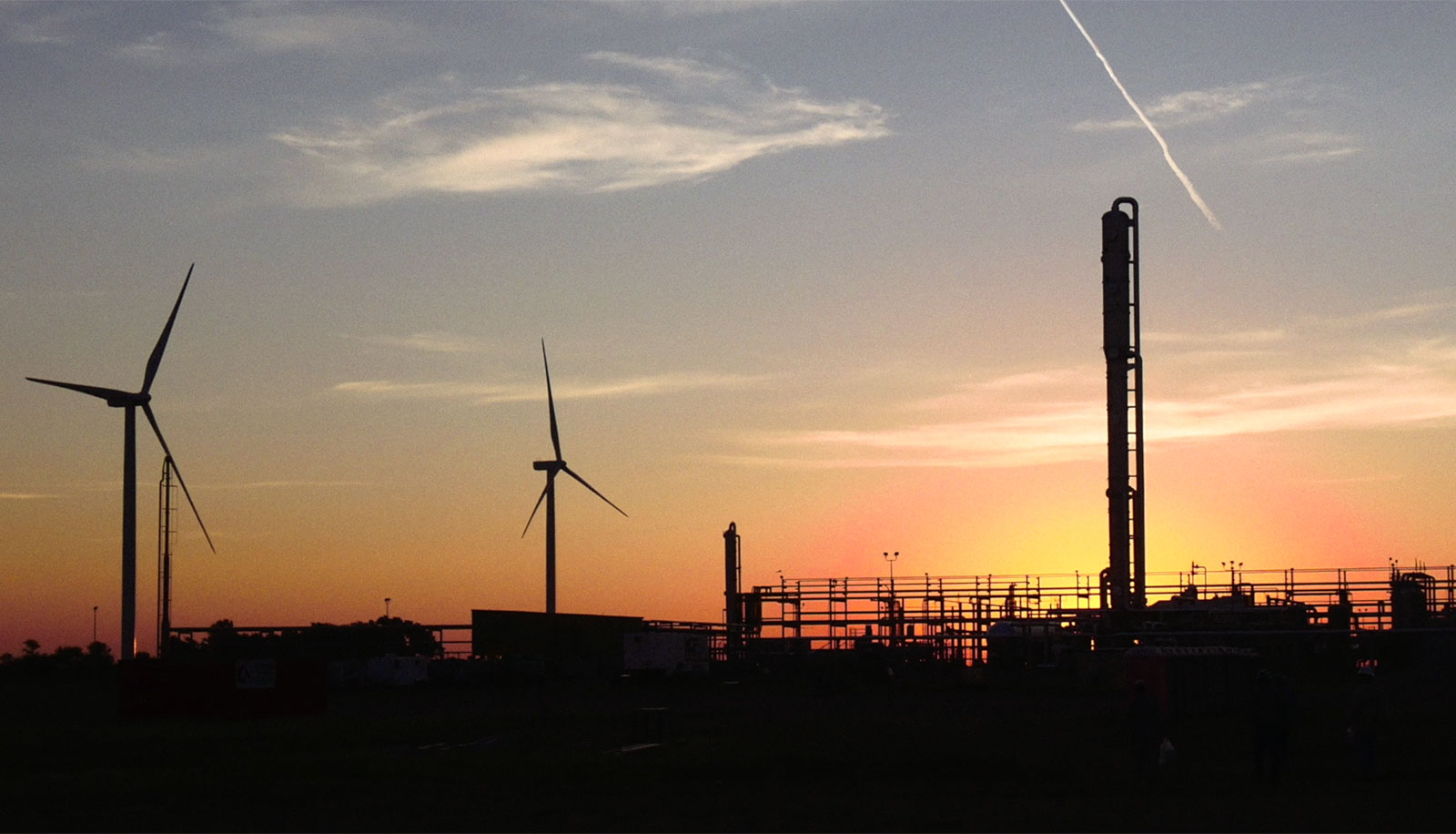
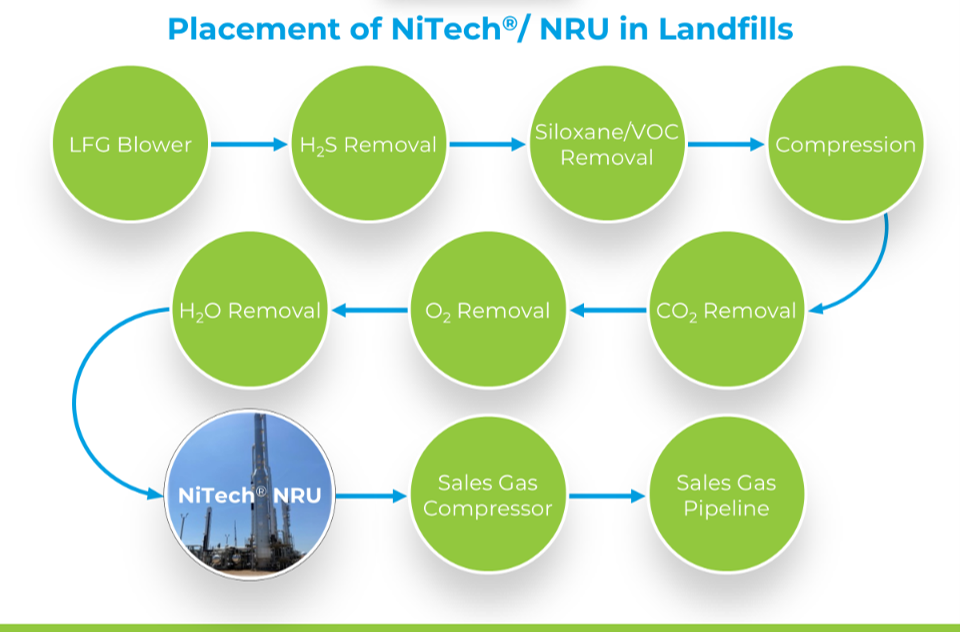
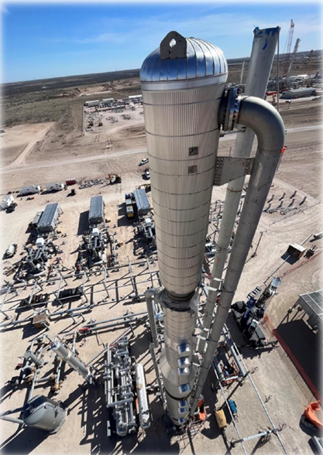
Landfill gas processing is advancing rapidly as operators search for efficient technologies to convert waste into renewable energy. Among the most effective solutions are cryogenic nitrogen rejection units (cryo-NRUs). These systems excel in maximizing methane recovery, reducing operational costs, scaling to meet growing project demands, and maintaining environmental compliance. For companies seeking to address environmental concerns while optimizing profitability, cryo-NRUs offer an exceptional path forward (Figure 1).
Reducing methane loss for greater profitability
Recovering high levels of methane is critical for landfill gas projects. Methane purity directly impacts its utility, from energy generation to pipeline injection. Cryo-NRUs are particularly effective at recovering methane even when feed gas has high nitrogen levels. Cryogenic technology includes a specialized process known as fractional distillation, where gases are cooled to extremely low temperatures to separate methane from nitrogen. The resulting methane stream is purer and meets energy and pipeline-grade standards.
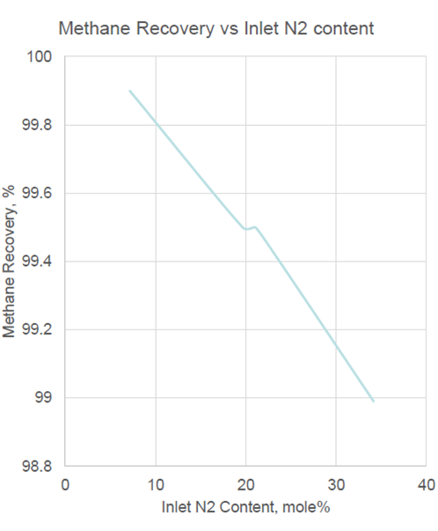
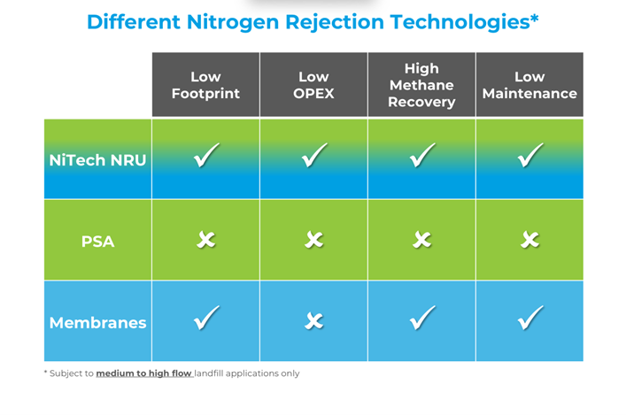
For example, one facility processing 6,000 standard cubic feet per minute (SCFM) of landfill optimized its methane recovery by upgrading to a BCCK cryo-NRU system. Previously, a significant portion of methane was lost, reducing potential profits (Figure 2). The new system captured the methane effectively, converting it into a usable energy resource. This yielded higher revenues and decreased the environmental footprint.
Investing smarter and ensuring long-term savings
While cryogenic NRUs may require a larger upfront investment compared to some alternatives, their operational efficiency and cost savings over time more than justify the expense. Cryo-NRUs consume less energy and require less frequent maintenance, making them ideal for projects with long operational lifespans.
For a medium-sized project, energy savings alone can range from US$1 to US$1.5 million annually. Over a 20-year lifecycle typical of landfill operations, cumulative savings can reach up to US$20 million. These efficiencies are rooted in cryogenic systems’ energy-conscious designs, particularly in compression processes, which represent a major cost in most methane recovery systems.
Although some installations include pre-treatment investments, such as oxygen, carbon dioxide, and water removal, operators typically offset these costs with long-term benefits. These operational improvements make investing in cryo-NRUs a financially sound decision.
Scaling operations to meet demands
Adaptability is a significant advantage for cryo-NRUs. These systems perform effectively for projects of all sizes—from small-scale landfills managing lower gas volumes to large-scale sites processing up to 16,000 SCFM. For example, BCCK’s cryo-NRUs are effective at as low as 3,200 SCFM. Additionally, many cryo-NRUs do not have heaters, blowers, pumps or an internal compressor. They operate with one skid and a vessel. Some competing technologies require multiple trains of rotating equipment, calling for multiple skids and have more complex process designs. Thanks to their modular and scalable designs, cryo-NRUs can seamlessly adjust as landfill gas volumes grow or shift, all while maintaining high-efficiency performance.
Alternative technologies often struggle to manage increased flow rates without dramatic declines in performance, but cryo-NRUs avoid these pitfalls. Their flexible structures position operators to expand operations, ensuring systems are future-proofed for growth opportunities.
Adhering to pipeline specs with cleaner outputs
One of the most immediate challenges landfill gas operators face is meeting strict pipeline-quality requirements. To be accepted into natural gas pipelines, RNG must meet certain standards for nitrogen and oxygen content. Cryo-NRUs shine in this area by producing exceptionally clean product streams, reducing nitrogen levels to below 0.5%, which exceeds most pipeline standards.
By avoiding the need for further downstream treatment, operators save time and resources while maintaining compliance. Additionally, streamlined designs in systems like BCCK’s cryo-NRUs minimize reliance on complex rotating machinery, improving reliability and cutting down on maintenance costs.
Managing nitrogen
The composition of landfill gas is rarely consistent. Factors like local climate, the type of waste decomposing in the landfill, and seasonal shifts can all influence gas composition. Cryo-NRUs are engineered to handle gas variations, including nitrogen levels as high as 90%. This makes them highly reliable for operators who may otherwise face plant downtime or reduced outputs during fluctuating conditions.
This improves methane recovery rates while streamlining operations and reducing overall system costs (Figure 3).
Maintaining environmental compliance
With rising environmental regulations, landfill operators must reduce greenhouse gas emissions while remaining profitable. Traditional methods often vent methane, creating environmental and compliance issues. Cryo-NRUs avoid such problems by emphasizing near-complete methane capture.
For example, BCCK’s cryo-NRUs fully comply with stringent U.S. EPA standards for methane control. Again, these units also provide significant economic benefits, including reduced electricity costs and higher volumes of saleable gas due to their methane recovery. These systems help operators mitigate environmental damage by integrating sustainability with economic performance.
Real-world cryo-NRU case studies
Solving Methane Recovery Challenges
A landfill facility in Klickitat County, Washington, struggled with poor methane recovery rates, limiting the production of high-quality RNG and reducing profitability. Methane losses posed risks with environmental regulations and constrained the facility’s ability to generate energy and revenue effectively. By developing BCCK’s NiTech® cryo-NRU system, which uses fractional distillation to efficiently reject nitrogen and recover methane, the facility saw a significant operational boost. The plant processed 5,000 SCFM of feed gas at higher recovery rates, reduced emissions, and achieved pipeline compliance with ease. The cost savings and environmental benefits enabled the facility to increase its profitability and boost its sustainability.
Increasing System Efficiency
Another facility processing landfill gas at 6,000 SCFM encountered inconsistent nitrogen levels that reduced system efficiency. This resulted in rising energy bills, missed revenue from wasted methane, and an ongoing struggle to meet pipeline standards. With the BCCK NiTech® cryo-NRU, the facility stabilized its operations, recovering higher rates of methane regardless of nitrogen fluctuations. The upgrade led to operational savings of over US$6 million annually. These improvements not only optimized their outputs but also significantly reduced their energy usage and maintenance costs, ensuring long-term success.
Practical benefits for landfill gas operations
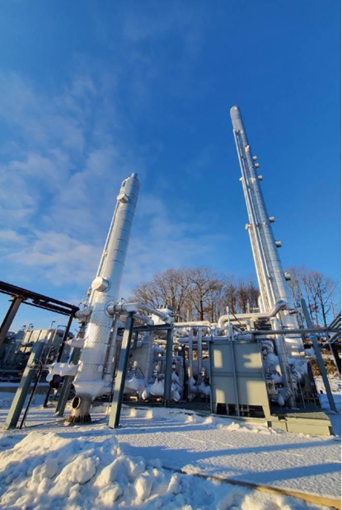
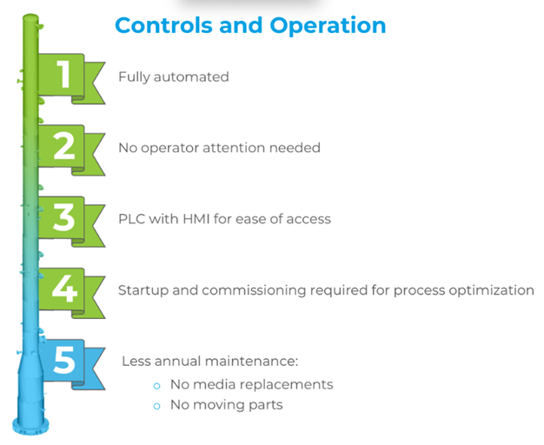
Cryogenic NRUs are designed with durability and practicality in mind. Their accessible layout allows for routine inspections with occasional adjustment. The absence of media replacements and moving parts lowers upkeep demands (Figure 4). This reduction in maintenance minimizes downtime and allows operators to focus their resources on other operational needs. With these advantages, cryo-NRUs present a dependable and efficient option for optimizing landfill gas projects.
Naomi Baker is BCCK’s Vice President of Engineering and holds a BS in Chemical Engineering from Texas Tech University. She is a registered engineer in the state of Texas.